
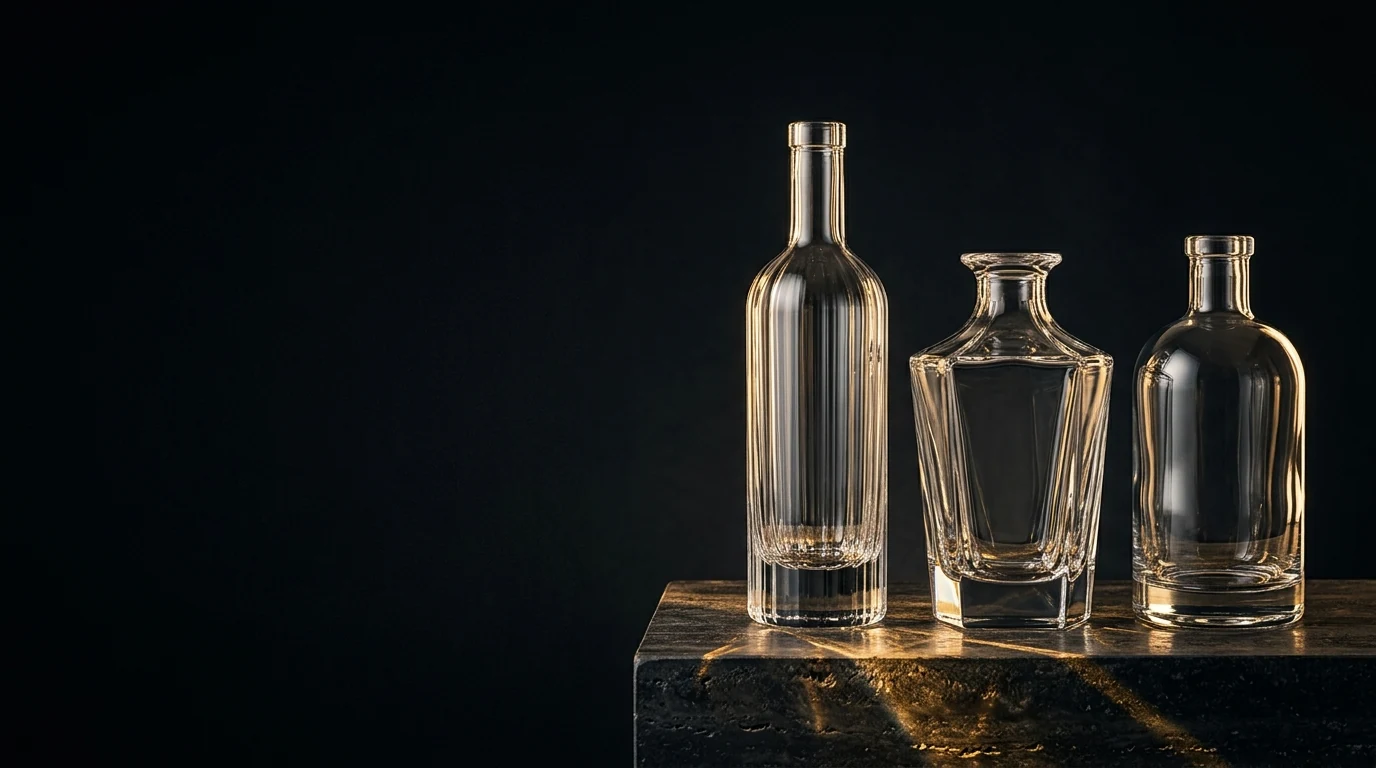
Why Glass Optical Purity Drives First-Touch Brand Equity
In European and North American spirits retail, the glass vessel communicates liquid quality long before the cork is drawn. While commodity beverage glass exhibits a faint greenish tint caused by residual ferric oxide (Fe₂O₃) in standard silica sand, Super Flint and Extra Flint formulations strictly control iron content below 0.015%–0.025%, producing crystal-like optical clarity.
For crystal-clear distillates such as botanical gin, ultra-premium vodka, and blanco tequila, any green cast visually dulls purity. For aged single malts, cognacs, and añejo tequilas, high-transmittance flint glass preserves authentic warm amber reflections under dim back-bar spotlights.
Comparing Commercial Flint Grades
| Specification | Standard Flint | High / Super Flint | Cosmetic Extra Flint |
|---|---|---|---|
| Iron Oxide (Fe₂O₃) | ~0.04% – 0.06% | 0.018% – 0.028% | < 0.015% |
| Light Transmittance | ~88% | 90% – 91.5% | > 92% |
| Typical 750ml Weight | 420g – 520g | 650g – 820g | 780g – 980g |
| Best Applications | Everyday wine, sauces, beer | Craft gin, vodka, tequila, reserve whisky | XO cognac, collector decanters, niche parfum |
| MOQ Guidance (VIT Glass) | 5,000+ pcs | 2,000 stock / 6,000 custom | 2,000 stock / 6,000 custom |
Engineering the Heavy Base (Punt) Without Stress Cracks
A dramatic 18mm–26mm solid glass base creates unmistakable perceived value in the hand, yet thick bases introduce distinct thermal dynamics inside the IS forming machine and annealing lehr:
- Controlled Gob Temperature: Extra mass at the heel cools more slowly than the shoulder; precise mold cooling prevents sunken bottoms (rockers) that cause instability on high-speed conveyor belts.
- Extended Annealing Curve: Heavy-base decanters require tailored time-temperature annealing profiles verified by polariscope internal stress inspection so the bottle withstands cold-chain shipping and ice-bucket thermal shock.
- Label Panel Flatness: Whether selecting a square monolith (
VIT-902) or fluted column (VIT-903), reserving a smooth, cylindrical or flat labeling band prevents paper creasing and air bubbles during automatic labeling.
“In luxury spirits, every 100 grams of base weight changes both center-of-gravity ergonomics and freight economics. Our DFM engineers balance perceived heft with 40HQ container optimization before cutting steel.”
Balancing Prestige Heft with ESG Lightweighting
Modern European importers increasingly evaluate Scope 3 glass emissions alongside luxury aesthetics. VIT Glass helps brands bridge both mandates through:
- Sculpted Internal Punts: Visual depth and thick-wall illusion achieved at 680g–720g instead of 950g, cutting glass mass and ocean freight weight by over 20%.
- Clean-Fuel Multi-Plant Furnaces & NNPB Lightweighting: Low-NOx natural-gas and electric-boosted furnaces paired with 350g–420g NNPB lightweighting and water-based UV-LED finishing cut glass mass and freight CO₂ up to 25%.
- 30%–70% PCR Recycled Cullet Integration: Every 10% recycled cullet reduces melting energy ~2.5%–3% while tailoring batch formulation to your target luminance grade.
Checklist Before Requesting Spirits Bottle Samples
- Confirm your target market nominal volume (700ml for EU/UK, 750ml for US/Americas, or dual-mold family).
- Specify bar-top cork bore diameter (commonly 18.5mm or 19.5mm inner neck diameter) and preferred head material (oak, walnut, aluminum, or glass).
- Request physical line-trial samples to test capping torque, wraparound label adhesion, and carton divider fit prior to mass production.
VIT GLASS ENGINEERING DESK
Need Engineering Validation for Your Bottle Project?
Share your target capacity, filling line specs, or artwork concepts with our Yuncheng engineering team for a free DFM review and sample kit.